The 2026 job search rewards focus. Sending more generic applications is usually weaker than sending fewer applications with stronger targeting, cleaner resumes, and better follow-through.
Key takeaway
Quick answer
Build a target list instead of applying randomly.
Tailor the top third of your resume for serious roles.
Use ATS and match-score checks before applying.
Track applications, follow-ups, and response rates weekly.
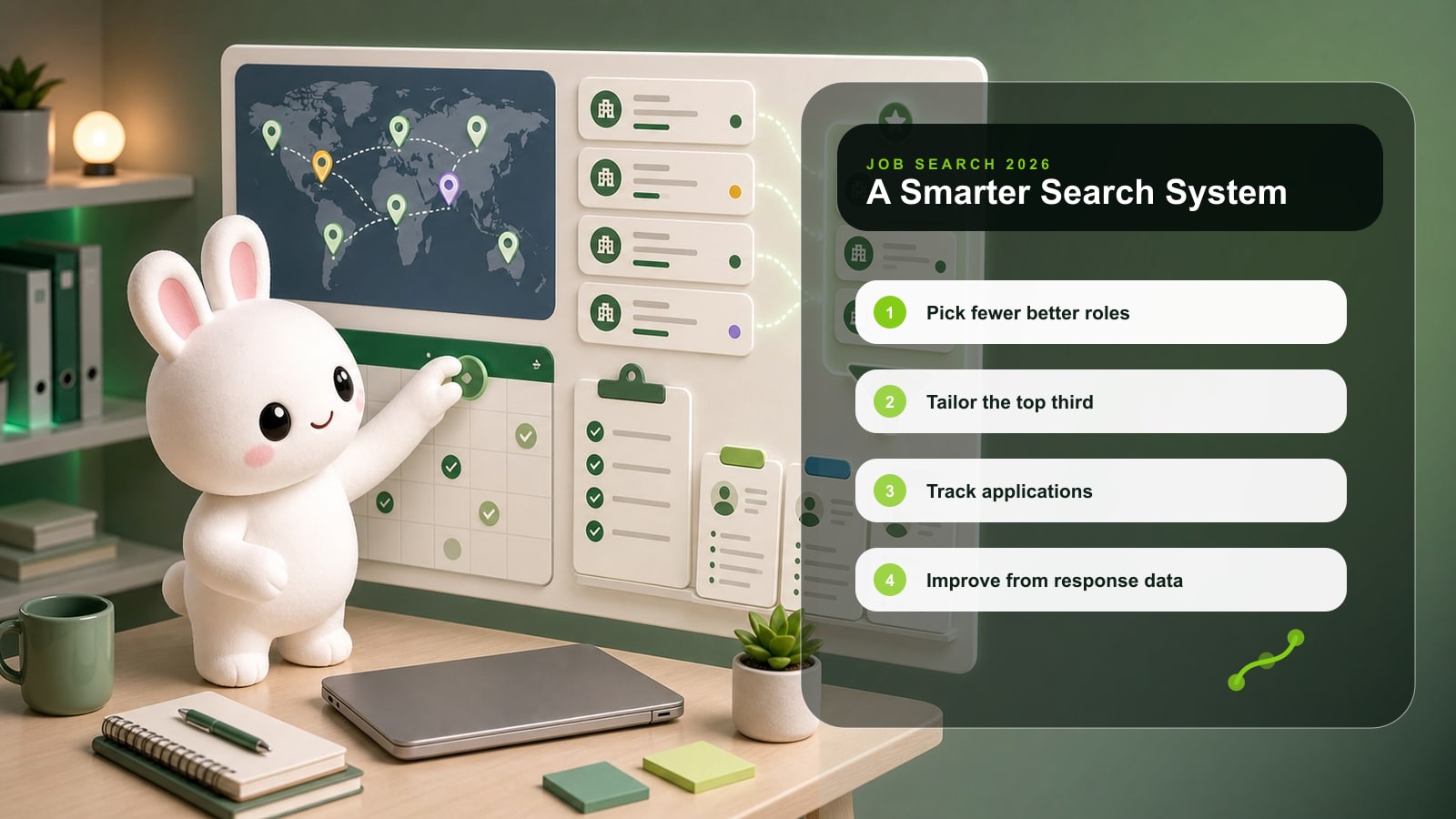
Search intent: what this page helps you do
This guide gives job seekers a practical weekly operating system for getting more interviews, not just a list of motivational tips.
The practical goal is not to make a resume or job-search document sound polished. The goal is to make the next reviewer understand your fit faster, with fewer assumptions and less friction.
10 strategies that still matter in 2026
Use these strategies as a workflow. The value comes from repeating the right actions and improving from data.
| Area | What strong candidates do | What to avoid |
|---|---|---|
| Targeting | Apply to roles where your evidence is already plausible. | Mass-applying to low-fit roles. |
| Resume tailoring | Edit the top third and recent bullets for each serious role. | Rewriting everything or changing nothing. |
| ATS checks | Fix parsing, formatting, and keyword gaps. | Obsessing over a perfect score. |
| Networking | Ask specific questions and build context. | Sending generic referral requests. |
| Tracking | Review response rates weekly. | Applying without learning what works. |
Step-by-step workflow
- 1Choose 2 to 3 target role families.
- 2Create a company and role target list.
- 3Build one strong base resume.
- 4Tailor versions for serious roles.
- 5Run ATS and match checks.
- 6Write targeted outreach for priority companies.
- 7Follow up at the right time.
- 8Track responses weekly.
- 9Improve weak resume sections based on patterns.
- 10Stop applying to roles with repeated low fit.
Before and after examples
| Weak version | Stronger version |
|---|---|
| Applied to 80 roles this week. | Applied to 12 strong-fit roles with tailored top thirds, match checks, and 5 targeted outreach notes. |
| Used the same resume everywhere. | Built separate versions for product analyst, revenue operations analyst, and customer success operations roles. |
| No response after applying. | Tracked source, role fit, resume version, follow-up date, and response outcome for each application. |
Use the stronger versions as patterns, not scripts. Replace the details with your real scope, tools, audience, numbers, and constraints.
Checklist before you use this advice
Key takeaway
Application checklist
You know the exact role families you are targeting.
Each serious application has a tailored resume version.
Your resume passes a basic ATS readability check.
You follow up only when appropriate.
You review response data every week.
Common mistakes
| Mistake | Why it hurts | Better move |
|---|---|---|
| Using volume as the only strategy. | More applications can mean more weak signals. | Improve targeting and resume fit. |
| Changing direction every day. | The resume and outreach become scattered. | Pick a few lanes and iterate. |
| Ignoring response data. | You miss what the market is telling you. | Track and adjust weekly. |
How Rezoomed helps
Rezoomed supports the full search loop: build a base resume, tailor it for roles, run ATS checks, compare match score, and keep cleaner versions for applications.
Use the relevant Rezoomed tool after you have a clear target role, not before. The tool is most useful when it has a real job description, a real resume, and a concrete outcome to improve.
Fast answers to common questions
Frequently asked questions
- 01+
How many jobs should I apply to each week?
There is no universal number. A focused batch of strong-fit applications usually beats a large batch of generic applications.
- 02+
Is networking still useful?
Yes, especially when it helps you understand the role, improve targeting, or get context before applying.
- 03+
Should I use AI in my job search?
Use AI to draft, compare, and improve. Do not use it to invent experience or send generic outreach at scale.
Final takeaway
The strongest applications are specific, readable, and easy to verify. Use this guide to remove uncertainty: show the role you want, prove the work you have done, and keep every claim defensible in an interview.
Sources and further reading
Related Rezoomed tools
- ATS Checker - Stress-test your resume before you apply.
- Match Score - Compare your resume to a target role and find the biggest fit gaps.