A follow-up can help when it is brief, respectful, and attached to a strong application. It cannot rescue a generic resume or an obviously weak fit.
Key takeaway
Quick answer
Wait about 10 to 14 days unless the employer gives a different timeline.
Do not follow up if the posting says not to.
Keep the message short and mention one concrete fit point.
Send one final follow-up only if another week passes without a response.
Search intent: what this page helps you do
This guide helps candidates decide when to follow up, what to say, and when to stop.
The practical goal is not to make a resume or job-search document sound polished. The goal is to make the next reviewer understand your fit faster, with fewer assumptions and less friction.
Follow-up timing and message framework
Good follow-ups lower friction. They remind the employer who you are without creating extra work.
| Area | What strong candidates do | What to avoid |
|---|---|---|
| Timing | Wait 10 to 14 days if no timeline is given. | Following up after 1 or 2 days. |
| Subject line | Use role title and application follow-up. | Vague or urgent subject lines. |
| Message body | Restate interest and one relevant strength. | Writing a second cover letter. |
| Tone | Helpful, concise, and respectful. | Demanding updates. |
| Stopping point | Send one final note, then move on. | Repeated messages. |
Step-by-step workflow
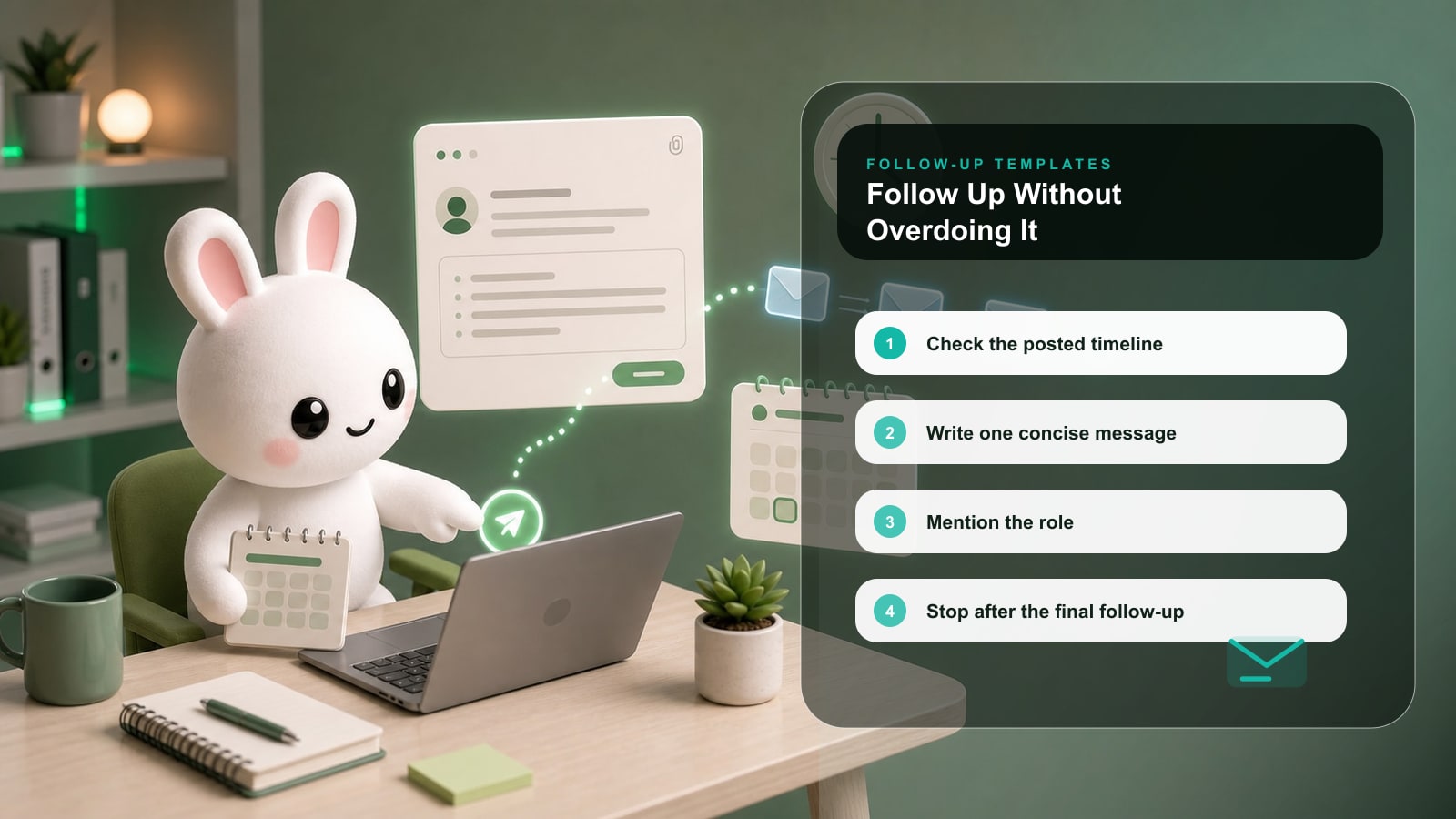
- 1Check the job posting and confirmation email for timelines.
- 2Wait the appropriate amount of time.
- 3Find the right contact if possible.
- 4Write a short note with role, date, and one fit point.
- 5Offer additional information if useful.
- 6Send one final follow-up later, then stop.
Before and after examples
| Weak version | Stronger version |
|---|---|
| Just checking on my application. Any updates? | I am following up on my application for the Product Analyst role submitted on May 2. My background in onboarding analytics and Tableau reporting seems closely aligned with the team needs. |
| Please let me know if I got the job. | If helpful, I would be glad to share additional context on my recent dashboard and retention analysis work. |
| I have not heard back and am disappointed. | Thank you again for your time and consideration. |
Use the stronger versions as patterns, not scripts. Replace the details with your real scope, tools, audience, numbers, and constraints.
Checklist before you use this advice
Key takeaway
Application checklist
You waited long enough.
The role title is clear.
The message is under 150 words.
You mention one specific fit point.
You do not send more than one final follow-up.
Common mistakes
| Mistake | Why it hurts | Better move |
|---|---|---|
| Following up too early. | It can look impatient. | Respect the timeline. |
| Writing too much. | Recruiters are busy. | Keep it short. |
| Following up on weak applications. | The note repeats weak fit. | Improve the resume first. |
How Rezoomed helps
Rezoomed ATS Checker and Match Score help strengthen the resume before you follow up, so the note points back to a better application.
Use the relevant Rezoomed tool after you have a clear target role, not before. The tool is most useful when it has a real job description, a real resume, and a concrete outcome to improve.
Fast answers to common questions
Frequently asked questions
- 01+
How long should I wait before following up?
Wait 10 to 14 days when no timeline is provided. Follow the employer timeline if one is given.
- 02+
Should I follow up on LinkedIn?
A short LinkedIn note can work if you have a relevant contact, but email is usually cleaner after applying.
- 03+
How many times should I follow up?
One first follow-up and one final follow-up is usually enough. After that, move on.
Final takeaway
The strongest applications are specific, readable, and easy to verify. Use this guide to remove uncertainty: show the role you want, prove the work you have done, and keep every claim defensible in an interview.
Sources and further reading
Related Rezoomed tools
- ATS Checker - Stress-test your resume before you apply.
- Match Score - Compare your resume to a target role and find the biggest fit gaps.