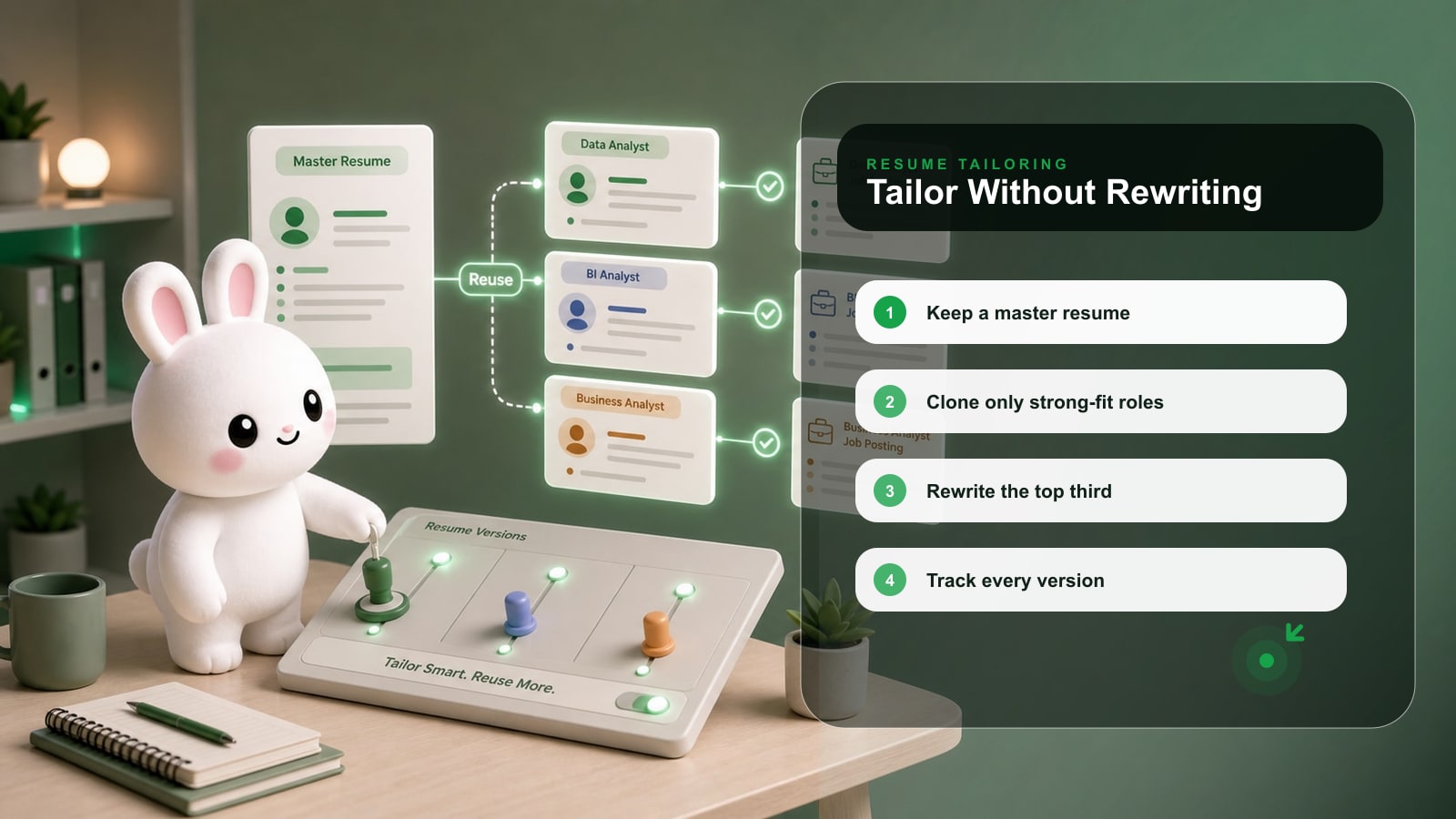
Tailoring your resume for each job does not mean rewriting your entire career every time. The efficient approach is to keep a strong master resume and create focused versions for serious applications.
Key takeaway
Quick answer
Keep one master resume with full detail.
Clone a targeted version only for strong-fit jobs.
Rewrite the summary, skills, and most relevant recent bullets.
Use job-description keywords only where they match real experience.
Search intent: what this page helps you do
This guide is for candidates who know tailoring matters but do not want to lose hours rebuilding resumes from scratch.
The practical goal is not to make a resume or job-search document sound polished. The goal is to make the next reviewer understand your fit faster, with fewer assumptions and less friction.
The no-rewrite tailoring system
A good system limits edits to the parts that influence first impressions and ATS matching most.
| Area | What strong candidates do | What to avoid |
|---|---|---|
| Master resume | Stores all credible experience, projects, and metrics. | Sending the master resume as-is to every job. |
| Target version | Narrows evidence to one role family. | Editing randomly without a job description. |
| Top third | Summary, skills, and first role reflect the posting. | Leaving the opener generic. |
| Keywords | Placed in context where truthful. | Stuffed into a skills list only. |
| Version control | Files are named and tracked clearly. | Losing track of which resume went where. |
Step-by-step workflow
- 1Build a master resume with full bullets and projects.
- 2Score the target job by fit before tailoring.
- 3Highlight repeated skills, tools, outcomes, and responsibilities.
- 4Rewrite the top third for the job.
- 5Move the most relevant bullets upward.
- 6Save the version with company and role in the filename.
- 7Run a final ATS and readability check.
Before and after examples
| Weak version | Stronger version |
|---|---|
| Generic summary for all jobs. | Customer success analyst targeting onboarding operations roles, with 4 years improving handoffs, reporting, and renewal-risk visibility. |
| Used Salesforce and dashboards. | Built Salesforce renewal-risk dashboard for 14 CSMs, reducing manual account review time by 6 hours weekly. |
| Resume file: resume.pdf. | Resume file: Avery-Collins-Stripe-Product-Operations-Resume.pdf. |
Use the stronger versions as patterns, not scripts. Replace the details with your real scope, tools, audience, numbers, and constraints.
Checklist before you use this advice
Key takeaway
Application checklist
You are tailoring only serious-fit jobs.
The top third matches the role language naturally.
Every added keyword is true.
The newest version has a clear filename.
You can explain every edited bullet in an interview.
Common mistakes
| Mistake | Why it hurts | Better move |
|---|---|---|
| Rewriting the whole resume every time. | It wastes time and creates inconsistency. | Edit the highest-impact sections. |
| Tailoring weak-fit jobs. | Low fit still performs poorly. | Prioritize roles where evidence already exists. |
| Letting AI replace your story. | The resume can become generic. | Use AI to sharpen your real proof. |
How Rezoomed helps
Rezoomed Resume Tailoring helps create role-specific versions from a base resume, while Match Score shows whether the version actually fits the posting.
Use the relevant Rezoomed tool after you have a clear target role, not before. The tool is most useful when it has a real job description, a real resume, and a concrete outcome to improve.
Fast answers to common questions
Frequently asked questions
- 01+
How much should I tailor my resume?
For most jobs, tailor the summary, skills, and top 5 to 8 bullets. Deep rewrites are only worth it for high-priority roles.
- 02+
Is tailoring the same as keyword stuffing?
No. Tailoring selects the most relevant true evidence. Keyword stuffing adds words without proof.
- 03+
Should I keep old resume versions?
Yes. Keep versions long enough to know what you submitted and prepare for interviews.
Final takeaway
The strongest applications are specific, readable, and easy to verify. Use this guide to remove uncertainty: show the role you want, prove the work you have done, and keep every claim defensible in an interview.
Sources and further reading
Related Rezoomed tools
- Resume Tailoring - Use Rezoomed Tailor Mode to adapt the strongest parts of your resume for a target role.
- Match Score - Use job-description comparison to decide what to rewrite and what to leave alone.