A software engineer resume should prove that you can build, debug, ship, and maintain systems. Tailoring does not mean adding every technology in the job description; it means moving the most relevant engineering evidence forward.
Key takeaway
Quick answer
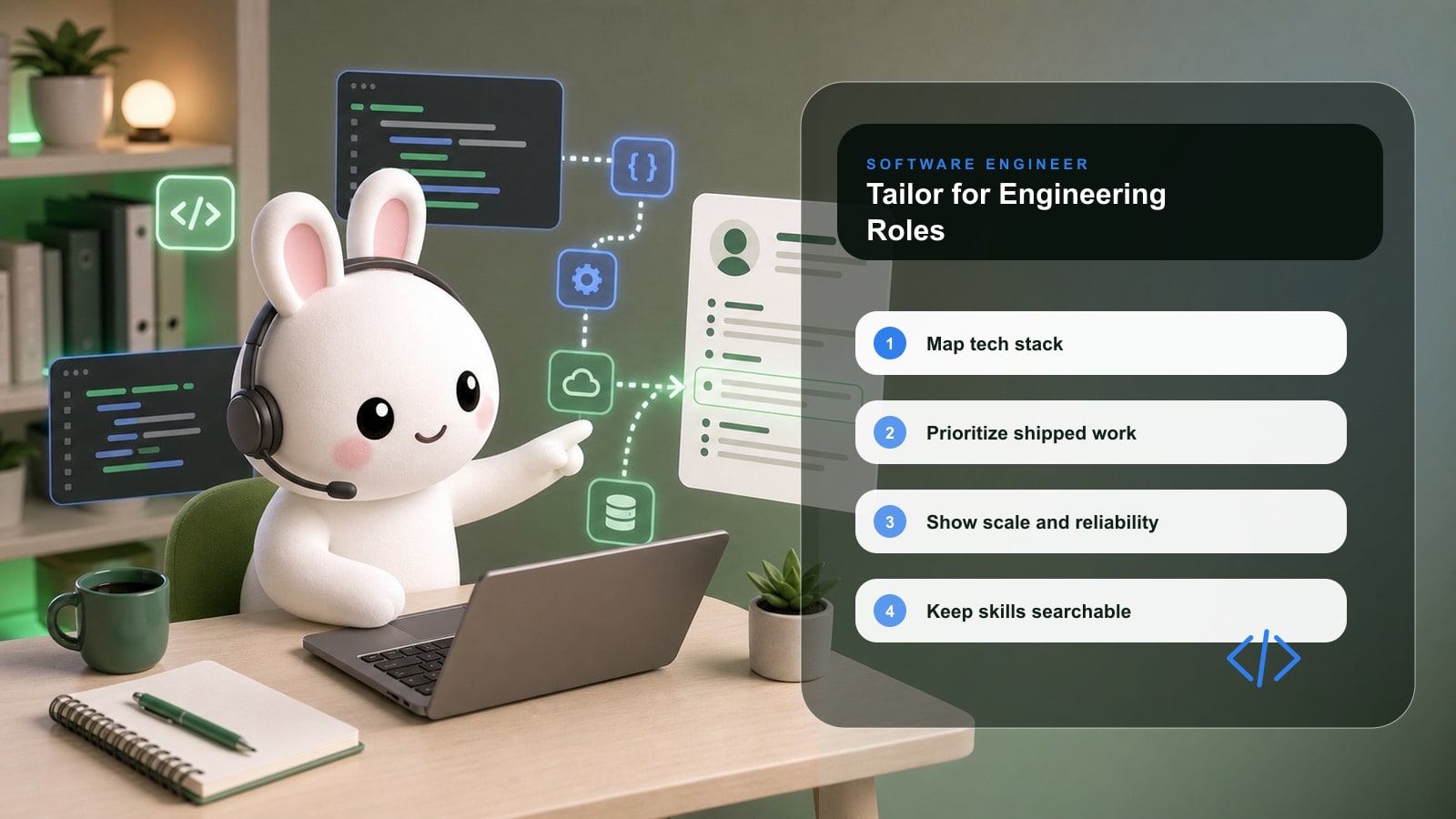
Map the job description into languages, frameworks, systems, responsibilities, and outcomes.
Show shipped work, scale, reliability, performance, security, or developer productivity impact.
Put tools in context inside bullets, not only in the skills section.
Keep formatting plain enough for both ATS parsing and technical recruiter scanning.
Search intent: what this page helps you do
This guide helps engineers turn a general resume into a role-specific application for backend, frontend, full-stack, platform, data, infrastructure, or product engineering roles.
The practical goal is not to make a resume or job-search document sound polished. The goal is to make the next reviewer understand your fit faster, with fewer assumptions and less friction.
Software engineer resume tailoring framework
Use the job description to decide which engineering proof belongs in the top third of the resume.
| Area | What strong candidates do | What to avoid |
|---|---|---|
| Tech stack | Match languages and frameworks you have used in real projects. | Listing tools you cannot discuss technically. |
| System impact | Show latency, uptime, cost, scale, or reliability changes. | Only saying built features. |
| Collaboration | Mention code reviews, design docs, product work, or incident response. | Sounding like you worked alone on every system. |
| Projects | Use projects when they prove the exact stack or problem space. | Adding toy projects that distract from stronger experience. |
| ATS format | Use searchable text and standard headings. | Complex GitHub-card layouts or two-column designs. |
Step-by-step workflow
- 1Highlight must-have technologies in the posting.
- 2Separate required skills from nice-to-have tools.
- 3Move the most relevant project or role bullet into the top half.
- 4Rewrite bullets around engineering outcomes: performance, reliability, scale, quality, or user impact.
- 5Group skills by category: Languages, Frameworks, Cloud, Data, Testing, DevOps.
- 6Remove unrelated tools that make the resume look unfocused.
Before and after examples
| Weak version | Stronger version |
|---|---|
| Built APIs for product features. | Built Node.js and PostgreSQL APIs for billing workflows, reducing checkout errors by 18% across 42K monthly sessions. |
| Improved app performance. | Reduced React dashboard load time from 4.8s to 1.9s by splitting bundles, memoizing heavy tables, and moving filters server-side. |
| Worked on AWS infrastructure. | Migrated 11 services to ECS with autoscaling policies, cutting weekly deployment rollback incidents by 32%. |
Use the stronger versions as patterns, not scripts. Replace the details with your real scope, tools, audience, numbers, and constraints.
Checklist before you use this advice
Key takeaway
Application checklist
The top third names the target engineering lane.
Skills are grouped and truthful.
Recent bullets include stack plus outcome.
Metrics cover scale, reliability, speed, cost, adoption, or quality where possible.
Projects add proof instead of padding.
Common mistakes
| Mistake | Why it hurts | Better move |
|---|---|---|
| Listing every technology ever touched. | It dilutes the signal for the target role. | Prioritize tools from real work that match the posting. |
| Using vague impact language. | Recruiters cannot judge engineering depth. | Show constraints, systems, and measurable outcomes. |
| Ignoring nontechnical collaboration. | Engineering hiring still tests teamwork. | Mention design docs, reviews, product partners, or incidents. |
How Rezoomed helps
Rezoomed Match Score helps compare your engineering resume against a job description, while Resume Tailoring helps rewrite the top third and recent bullets without starting over.
Use the relevant Rezoomed tool after you have a clear target role, not before. The tool is most useful when it has a real job description, a real resume, and a concrete outcome to improve.
Fast answers to common questions
Frequently asked questions
- 01+
Should software engineers include GitHub links?
Include GitHub if it contains polished, relevant work. Do not link to abandoned repos that weaken the application.
- 02+
How many technologies should be in the skills section?
Enough to match the role honestly. Group them by category and remove weak or outdated tools.
- 03+
Should I tailor every engineering resume?
Tailor serious applications. A backend platform role and frontend product role should not receive the same resume.
Final takeaway
The strongest applications are specific, readable, and easy to verify. Use this guide to remove uncertainty: show the role you want, prove the work you have done, and keep every claim defensible in an interview.
Sources and further reading
Related Rezoomed tools
- Resume Tailoring - Use Rezoomed Tailor Mode to adapt the strongest parts of your resume for a target role.
- Match Score - Use job-description comparison to decide what to rewrite and what to leave alone.