
I have spent ten years inside technical recruiting pipelines, and I have never watched a job title go from obscure to everywhere as fast as "forward deployed engineer." Eighteen months ago it was a Palantir thing. Now it is in my inbox every week, the pay bands keep climbing, and the candidates who land these roles are not always the strongest pure coders. They are the ones who can build and sit across from a customer without freezing.
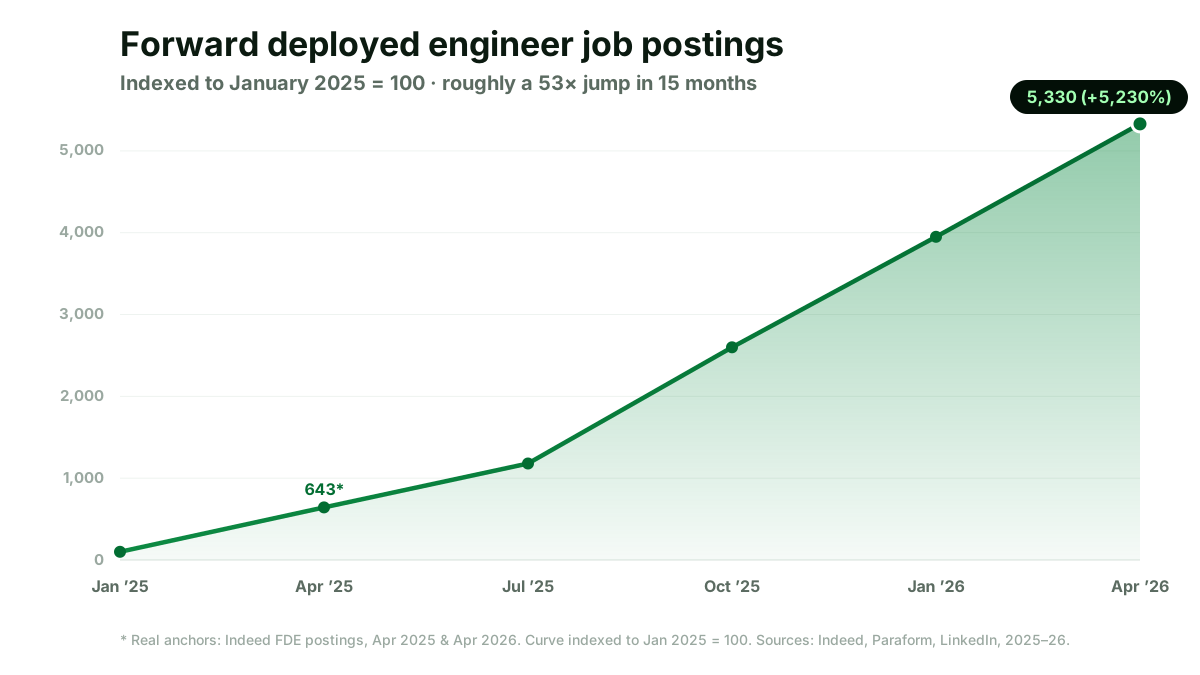
The numbers behind that shift are not subtle. Forward deployed engineer postings grew about 800% on LinkedIn between January and September 2025. On Indeed, openings went from roughly 643 in April 2025 to more than 5,330 a year later — north of a 5,000% increase over early-2025 levels, per analysis from Paraform and reporting gathered by BigGo Finance.
So if you can write production code and hold a room, this is one of the best-paid, fastest-moving moves available to you in 2026. Below is what the role really is, what it pays, which companies are hiring, a step-by-step plan to break in, and how to position your resume so it clears the screen and reaches a human.
Key takeaway
The short version
FDE postings are up 5,000%+ since January 2025, and October 2025 was the single biggest month on record.
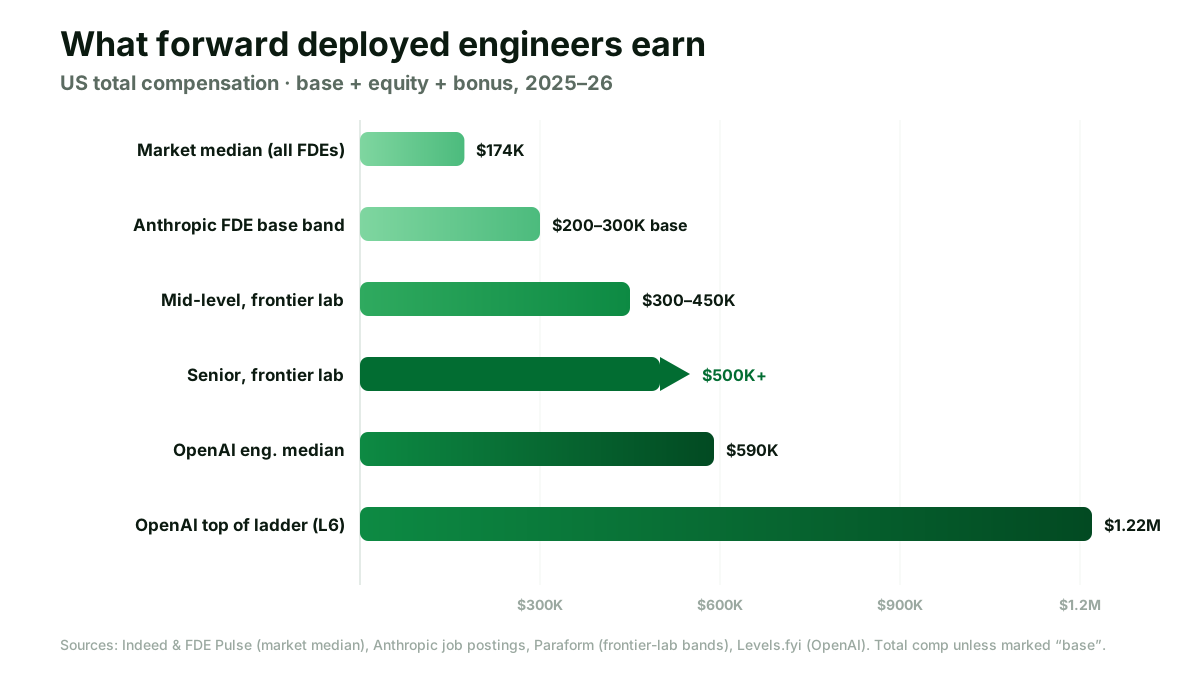
Base pay at frontier labs runs $200K to $300K; senior total comp clears $500K and climbs well past $1M at the top.
Half the job is elite engineering. The other half is customer judgment — and that second half is where most strong engineers lose the offer.
Hiring managers screen hard for one signal: have you owned a real outcome inside a messy, real-world customer environment?
What is a forward deployed engineer?
A forward deployed engineer (FDE) is a software engineer who embeds inside a customer's environment and makes the product actually work in production. Not a demo. Not a slide. Working software, wired into the customer's real systems, owned until it delivers value.

The role started at Palantir in the mid-2000s, and it started out of necessity. Palantir's first customers were intelligence and defense agencies — the CIA, the NSA, later the U.S. Army — whose data lived behind walls that made normal product discovery impossible. You could not run a discovery call with the NSA. So Palantir sent engineers physically into those environments to learn the problem by building inside it. Internally it called them "Deltas," paired with domain-expert "Echo" teams, and for years it ran more of these forward deployed engineers than traditional product engineers. The Pragmatic Engineer and Palantir's own blog walk through that history if you want the long version.
Twenty years later, the AI industry hit the exact same wall. A model demo wins the meeting; a working deployment wins the renewal. And the space between "wowed them in the demo" and "runs reliably on their data" is precisely where deals quietly die. The FDE is the person who lives in that space. Box CEO Aaron Levie called it "one of the most in-demand roles in tech, and one of the most critical functions for bringing AI to life," and for once the executive quote is not an exaggeration.
Why forward deployed engineer jobs grew 5,000% in a year
Three things happened at once.
AI moved from the lab to the customer's data center. Through 2023 and 2024 the labs were proving what models could do. In 2025 the race turned to getting those models running inside real businesses, and that work cannot be done remotely from a research org.
The demos stopped surviving contact with reality. Enterprise data is fragmented, permissions are a swamp, and a model that aced a benchmark can faceplant on a client's actual workflow. Someone has to debug it on-site, and that someone is the FDE.
And then every serious AI company copied Palantir at the same time. The model now shows up at OpenAI, Google Cloud, Anthropic, Scale AI, and Stripe, among others. Google Cloud CEO Thomas Kurian said outright that the company is ramping FDE hiring to keep up with client demand. When the biggest names all reach for the same role in the same year, you get a 5,000% spike — roughly 8,500 new FDE jobs created in the U.S. between 2023 and 2025.
If you are eyeing a specific lab, it is worth reading our deeper playbooks on how to land a job at OpenAI, how to land a job at Anthropic, and how to land a job at Stripe alongside this guide.
Forward deployed engineer salary: what the role actually pays
This is the question that brought most of you here, so let me be precise. "Forward deployed engineer" now stretches across a wide band — from a mid-market SaaS implementation job to an elite frontier-lab seat — and the pay reflects that range.
| Level / Employer | Compensation | Notes |
|---|---|---|
| Broad-market median | ~$174K total | All FDE roles; about 70% include equity (FDE Pulse) |
| Anthropic FDE | $200K to $300K base | Advertised base band, before equity |
| Mid-level, frontier lab | $300K to $450K total | Base + equity + bonus (Paraform) |
| Senior, frontier lab | $500K+ total | Scarce talent, real leverage |
| OpenAI engineering, median | ~$590K total | Median of the SWE ladder FDEs sit on (Levels.fyi) |
| OpenAI, top of ladder (L6) | $1.22M+ total | Equity dominates at senior levels |
Two details matter more than the headline. First, FDEs get paid as engineers, not salespeople. In one review of verified roles, zero percent carried a sales quota, even though the job is relentlessly client-facing. Second, AI fluency itself prints money: Paraform pegs the premium for AI literacy at $30K to $60K in base salary over a traditional FDE role. The viral "$500K" figure is real, but read it correctly — it is a senior, frontier-lab number, not an entry point.
What a forward deployed engineer does all day
Drop the title and a typical week looks like this:
- Turn vague complaints into technical work. "The AI keeps getting it wrong" becomes a real diagnosis: retrieval quality, prompt design, stale data, broken permissions, missing evals.
- Build and integrate fast. You write production code — LLM pipelines, API integrations, the glue between the product and the customer's stack on AWS, GCP, or Azure.
- Tune the parts that refuse to sit still. Prompt chains, evaluation frameworks, observability so you can see how the model behaves once real users hit it. You do not hand off and walk away; you keep calibrating.
- Read the room. You explain trade-offs to non-technical stakeholders in their language and keep the relationship warm enough to keep shipping.
- Feed the product team. The best FDEs, as Underdog's guide puts it, "convert customer chaos into product insight the company can reuse." You are the sharpest signal the company has about what to build next.
That blend is why the pay is what it is. The job wants the depth of a senior engineer, the instincts of a solutions consultant, and a comfort with ambiguity most engineers never build.
Forward deployed engineer vs. ML engineer vs. solutions architect
Candidates mix these up constantly, and getting the distinction right will sharpen how you pitch yourself.
| Role | Talks to customers? | Owns production? | Measured by |
|---|---|---|---|
| Forward deployed engineer | Constantly | Yes, in the customer's environment | Customer value shipped and kept |
| Machine learning engineer | Rarely | Yes, internally | Model performance |
| Solutions architect | Often | Mostly the design and sales phase | Deal closed, architecture sound |
| Software engineer | Rarely | Yes, internal product | Features and reliability |
Paraform's one-liner is the cleanest way to remember it: "ML engineers rarely talk to customers. Forward deployed AI engineers talk to customers constantly."
Which companies hire forward deployed engineers
The hiring list spans frontier labs, infrastructure, and the application layer: OpenAI, Anthropic, Google Cloud, Palantir, Scale AI, Stripe, Glean, Sierra, Decagon, Cresta, Hippocratic AI, and Anysphere (Cursor), plus a long tail of enterprise AI startups. Live OpenAI roles sit on their careers page, and trackers like FDE Pulse aggregate openings and pay across the market.
Skills you need to become a forward deployed engineer
Key takeaway
What hiring managers actually screen for
Engineering fundamentals strong enough to build and debug production systems under real constraints.
AI tooling fluency: prompt engineering, agent design, evaluation frameworks, and libraries like LangChain or LlamaIndex.
Cloud and integration experience across AWS, GCP, or Azure and the customer's messy systems.
Customer judgment: comfort with ambiguity and the ability to explain trade-offs to non-engineers.
A track record of owning outcomes, not just closing tickets.
You do not need all five at expert level. The combination that is genuinely rare — and genuinely valuable — is a strong engineer who is also good with people. Most candidates lean hard one way. The offers go to the ones who can prove both.
How to become a forward deployed engineer (and get the interview)
Nobody majors in this, and almost nobody starts here. The people I see land FDE roles transition in from software engineering, data engineering, or scrappy early-stage startup jobs where they had to do a bit of everything. Here is the path that works.
1. Build one story that proves both halves. You need a single project or role that shows deep technical work and real customer impact together. "Shipped an AI feature" is forgettable. "Embedded with a customer for six weeks, rebuilt their retrieval pipeline, cut hallucinated answers 40%, then turned the fix into a reusable internal tool" is the exact shape of the thing they are hiring for.
2. Get fluent in production AI, not toy AI. Ship something real with an LLM — a retrieval system, an agent, an eval harness. Knowing how models fail in the wild, and how you actually diagnosed it, is the most valuable thing you can put on the table in an interview.
3. Prepare for all three interview axes. Across the hiring guides, FDE loops test the same trio: core engineering, system design under real constraints (not whiteboard fantasy), and customer judgment. Have a story ready for each. The customer-judgment round is where strong engineers most often get dinged, so rehearse it like it counts, because it does.
4. Speak the company's dialect. Each shop frames the role differently — Palantir's "Deltas," OpenAI's "Model Deployment for Business," Google's solutions-led language. Mirror the posting's exact wording in your application and resume.
5. Tailor every single application. With postings up 5,000%, the pools are deep and the screens are ruthless. One generic resume sprayed across ten FDE openings loses to one sharp resume aimed at a single role. Our guide on tailoring your resume for each job without starting over shows how to do that without burning a weekend per application.
How to get your resume shortlisted for FDE roles
Here is what candidates underrate: a human is not the first reader. For most of these roles, an applicant tracking system reads your resume before anyone in the building does, and the FDE vocabulary is specific — "production," "customer-facing," "deployment," "LLM," "integration," "stakeholder," "ambiguity." Describe the same experience in different words and the software filters you out before a single person learns how good you are. If you want the mechanics, our breakdown of what an ATS resume checker actually tests and the best resume keywords to match a job description go deeper.
Mirror the posting's language: "forward deployed," "production deployment," "customer environment."
Assume a recruiter will mentally translate "client implementation" into "forward deployed."
Lead every bullet with a shipped outcome and a number.
List duties and tools with no result attached.
Put the technical depth and the customer impact in the same story.
Bury the customer-facing work in one throwaway line.
Tailor a focused version per role.
Reuse one generic engineering resume everywhere.
The gap between a strong FDE candidate and a shortlisted one is almost never raw talent. It is positioning. The same six months of work can read as "did some implementation projects" or as "owned production AI deployments inside enterprise customer environments." Identical facts, opposite outcomes.
How Rezoomed helps you get shortlisted
This is the precise problem [Rezoomed](https://www.rezoomed.com) was built to solve. It is more than a resume builder: you can build your resume, check its ATS strength, compare it directly against a specific job description, and export a cleaner, role-specific version, all in one place.
For an FDE search, that means you can:
- Paste the OpenAI, Anthropic, or Palantir posting and see exactly which keywords and skills your resume is missing — the idea behind our job description match score.
- Get a match score against that role before you apply, so you tailor instead of guessing.
- Confirm the ATS can actually parse your file — clean structure, correct metadata, no formatting that scrambles in the pipeline.
- Spin up a focused version per application without rebuilding from scratch each time, the way we recommend in our resume tailoring guide.
Watch what positioning does to the same line:
Worked with enterprise clients to implement AI features and resolve technical issues.
Embedded with 3 enterprise customers as a forward deployed engineer, rebuilt their RAG pipeline in production, and cut hallucinated responses 40% — then packaged the fix into a reusable internal eval tool.
The role is hot, the pay is real, and the applicant pools are crowded. A resume that mirrors the job, leads with outcomes, and clears the ATS is what turns a market that is 5,000% bigger into your offer instead of someone else's. Try Rezoomed before your next FDE application.
Fast answers to common questions
Frequently asked questions about forward deployed engineers
- 01+
What is a forward deployed engineer?
A forward deployed engineer is a software engineer who embeds inside a customer's environment to deploy, integrate, and tune a product — usually AI — until it runs reliably in production. The role was pioneered at Palantir and is now central to how frontier AI labs ship to enterprise customers.
- 02+
How much does a forward deployed engineer make?
The broad-market median is around $174K total compensation, but frontier labs pay far more: $200K to $300K base, $300K to $450K total at mid-level, and $500K+ at senior. At OpenAI, the engineering ladder these roles sit on has a median near $590K and tops out above $1.2M.
- 03+
Why are there so many forward deployed engineer jobs right now?
As AI moved from research demos to enterprise production in 2025, companies needed engineers who could make models work inside messy real-world systems. Postings rose more than 5,000% versus January 2025 levels, with OpenAI, Anthropic, Google Cloud, Palantir, and Stripe all hiring hard.
- 04+
Do I need a machine learning background to become an FDE?
Not deep ML research, but you do need production AI fluency — building with LLMs, prompt engineering, evals, and integrations — plus strong general engineering and genuine customer-facing ability. The well-paid, rare combination is technical depth and people skills together.
- 05+
How do I get shortlisted for a forward deployed engineer role?
Tailor your resume to each posting using its exact language, lead every bullet with a shipped outcome, show technical and customer impact in one story, and make sure it clears the ATS. Tools like Rezoomed check your ATS strength and match score against a specific job description before you apply.
Sources
- The New Stack — Forward deployed engineer is AI's hottest job
- Paraform — What is a forward deployed AI engineer?
- Paraform — How demand grew 10x in 18 months
- BigGo Finance — 800% surge in FDE jobs
- Bloomberry — I analyzed 1,000 FDE jobs
- Levels.fyi — OpenAI software engineer compensation
- Pragmatic Engineer — What are forward deployed engineers?
- Palantir — A day in the life of a forward deployed software engineer
- Underdog — Forward deployed engineer 2026 career guide
- FDE Pulse — FDE jobs and salary data
Related Rezoomed tools
- ATS Checker - Check structure, keywords, and readability before sending your resume.
- Pricing - See the full Rezoomed workflow if you need more than a one-off resume check.