A job description match score tells you how closely your resume maps to a specific posting. It is useful because a resume can be strong in general and still weak for one exact role.
Key takeaway
Quick answer
A match score compares resume content against skills, tools, responsibilities, and outcomes in the job description.
Use it to prioritize edits, not to predict hiring.
Improve the score by adding truthful, role-relevant proof.
Do not chase 100 if the resume becomes repetitive or unnatural.
Search intent: what this page helps you do
This guide helps you understand resume match scoring and use it as a practical editing tool.
The practical goal is not to make a resume or job-search document sound polished. The goal is to make the next reviewer understand your fit faster, with fewer assumptions and less friction.
What a match score measures
Different tools score differently, but useful match scores usually look at these areas.
| Area | What strong candidates do | What to avoid |
|---|---|---|
| Skills overlap | Matches real tools, methods, and capabilities. | Adding skills you cannot defend. |
| Responsibility fit | Shows you have done similar work. | Only matching vague verbs. |
| Seniority signals | Includes ownership, scope, leadership, or complexity. | Ignoring level expectations. |
| Keyword context | Keywords appear in bullets and sections naturally. | Dumping terms into a single list. |
| Readability | The resume remains clear to humans. | Optimizing until it sounds robotic. |
Step-by-step workflow
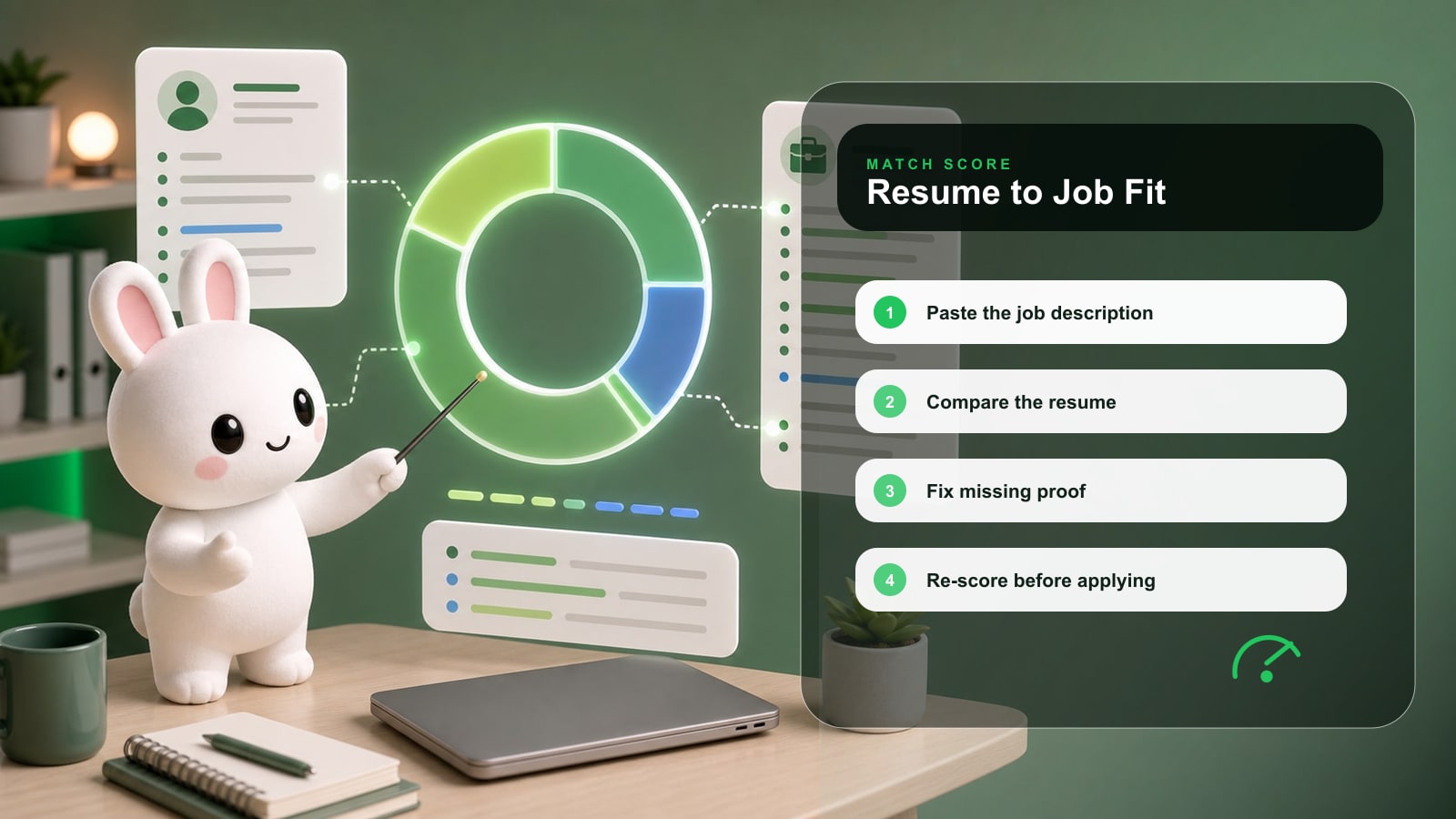
- 1Paste the full job description into the match tool.
- 2Review missing skills and repeated requirements.
- 3Separate true gaps from wording gaps.
- 4Rewrite bullets where your experience already proves the requirement.
- 5Add missing tools only if you used them.
- 6Re-score and then do a human readability pass.
Before and after examples
| Weak version | Stronger version |
|---|---|
| Job asks for executive reporting; resume says made reports. | Built executive KPI packet for CFO review, resolving 23 data inconsistencies across revenue and headcount sources. |
| Job asks for customer onboarding; resume says helped clients. | Led onboarding workflow for 45 enterprise accounts, improving first-response time by 28%. |
| Job asks for SQL; resume only lists data analysis. | Wrote SQL queries across 8M rows to identify refund drivers and support policy changes. |
Use the stronger versions as patterns, not scripts. Replace the details with your real scope, tools, audience, numbers, and constraints.
Checklist before you use this advice
Key takeaway
Application checklist
The score is based on a real job posting.
You know which gaps are real and which are wording gaps.
Every added keyword appears where it belongs.
The top third reflects the target role.
The final resume still sounds natural.
Common mistakes
| Mistake | Why it hurts | Better move |
|---|---|---|
| Treating score as a hiring prediction. | Hiring depends on fit, timing, competition, and human judgment. | Use score to improve the resume only. |
| Chasing 100. | It can make the resume unnatural. | Aim for strong fit and readability. |
| Adding false skills. | It creates interview risk. | Only add what you can explain. |
How Rezoomed helps
Rezoomed Match Score compares your resume to a target posting and turns the score into specific edits: missing terms, weak sections, and role-fit opportunities.
Use the relevant Rezoomed tool after you have a clear target role, not before. The tool is most useful when it has a real job description, a real resume, and a concrete outcome to improve.
Fast answers to common questions
Frequently asked questions
- 01+
What is a good job description match score?
Scores vary by tool. In general, use the score to compare versions and prioritize fixes rather than treating one number as universal.
- 02+
Can a low match score still get interviews?
Yes, but a low score often means the resume is too generic or missing obvious wording for the target role.
- 03+
Should I optimize for ATS or humans?
Both. A good match score should help the resume become clearer for software and recruiters.
Final takeaway
The strongest applications are specific, readable, and easy to verify. Use this guide to remove uncertainty: show the role you want, prove the work you have done, and keep every claim defensible in an interview.
Sources and further reading
Related Rezoomed tools
- Match Score - See how closely your resume maps to a specific job before you spend time applying.
- ATS Checker - Tighten structure and baseline ATS readability before optimizing for role match.