The best resume keywords are not magic words. They are the employer language that accurately describes your real skills, tools, responsibilities, and outcomes.
Key takeaway
Quick answer
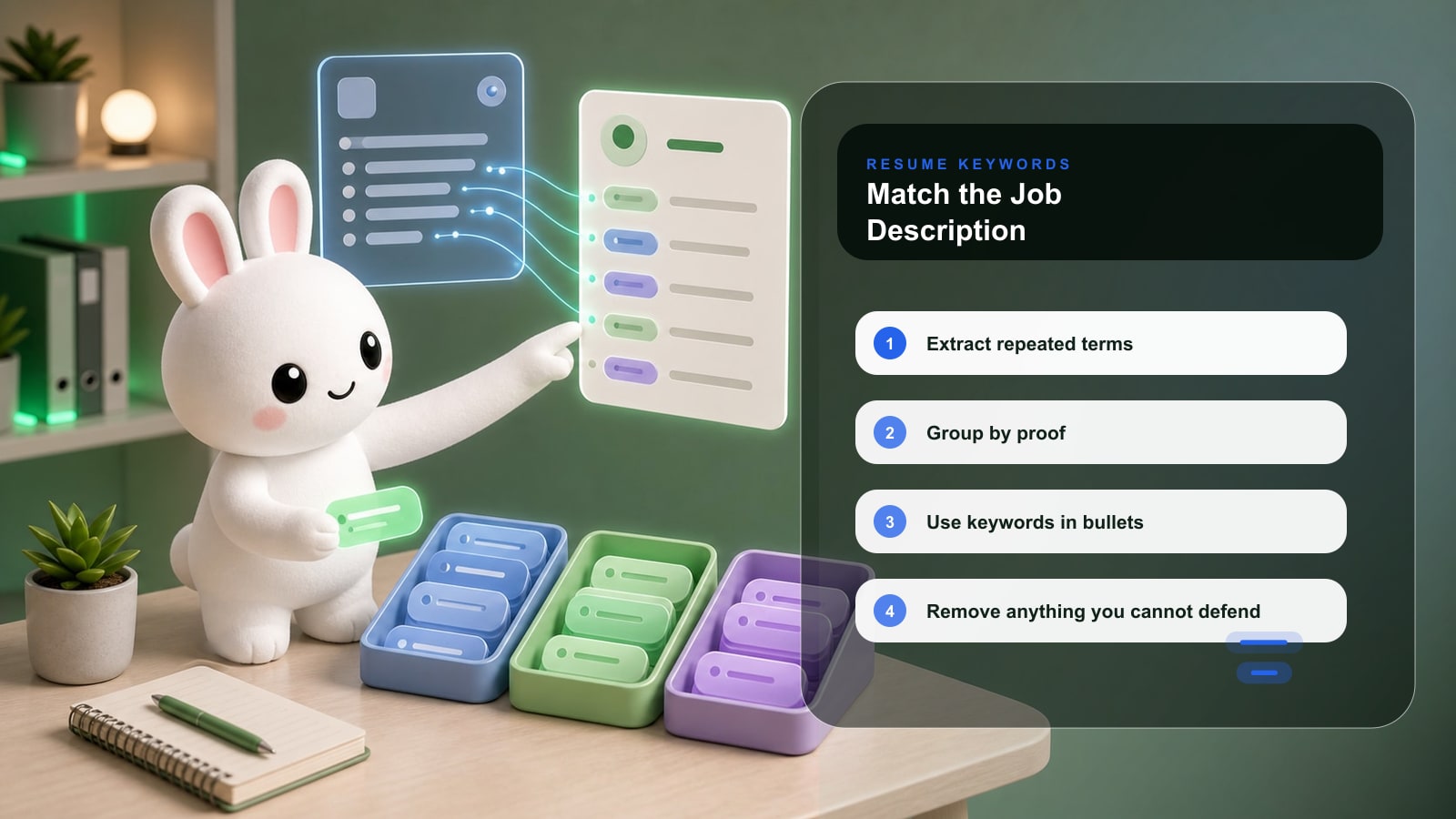
Pull keywords from repeated skills, tools, responsibilities, certifications, and outcomes in the job description.
Place keywords in the summary, skills section, and experience bullets where they are true.
Use exact phrasing for important tools and certifications.
Avoid copying full sentences or adding skills you cannot defend.
Search intent: what this page helps you do
This guide helps you turn a job description into a truthful keyword map for your resume.
The practical goal is not to make a resume or job-search document sound polished. The goal is to make the next reviewer understand your fit faster, with fewer assumptions and less friction.
How to find the best resume keywords
Keywords work best when they are supported by proof. Use the table below to separate useful terms from filler.
| Area | What strong candidates do | What to avoid |
|---|---|---|
| Hard skills | Use exact names: SQL, Salesforce, React, GA4, QuickBooks. | Replacing exact tools with vague phrases. |
| Responsibilities | Mirror real work: customer onboarding, incident response, variance analysis. | Copying responsibilities you have not done. |
| Certifications | List official names and acronyms. | Implying credentials you do not have. |
| Business outcomes | Use terms like retention, activation, cost reduction, risk, compliance. | Only listing verbs with no result. |
| Soft skills | Prove communication, leadership, and collaboration through bullets. | Dumping soft skills into a keyword list. |
Step-by-step workflow
- 1Copy the job description into a document.
- 2Highlight repeated nouns, tools, methods, and outcomes.
- 3Group terms into must-have, nice-to-have, and irrelevant.
- 4Add exact tools and certifications to Skills when true.
- 5Rewrite experience bullets so important keywords appear in context.
- 6Run one final read to remove stuffing.
Before and after examples
| Weak version | Stronger version |
|---|---|
| Skills: leadership, communication, data. | Skills: SQL, Tableau, cohort analysis, executive reporting, customer segmentation. |
| Managed customers. | Led enterprise customer onboarding for 42 accounts, using Salesforce and renewal-risk reporting to improve first-value milestone completion. |
| Worked with cloud. | Maintained AWS Lambda and S3 workflows processing 2M daily events for fraud monitoring. |
Use the stronger versions as patterns, not scripts. Replace the details with your real scope, tools, audience, numbers, and constraints.
Checklist before you use this advice
Key takeaway
Application checklist
You can explain every keyword in an interview.
Keywords appear in both Skills and Experience when important.
Exact tool names are spelled correctly.
The resume still reads naturally.
You removed terms that do not match your background.
Common mistakes
| Mistake | Why it hurts | Better move |
|---|---|---|
| Adding invisible keywords. | It is dishonest and can break trust. | Use visible, truthful content. |
| Copying the posting word for word. | It sounds unnatural and may fail interviews. | Translate requirements into your real evidence. |
| Using only soft skills. | They are hard to verify alone. | Show soft skills through outcomes. |
How Rezoomed helps
Rezoomed Match Score identifies job-description terms and helps you decide which keywords belong in the resume based on your actual experience.
Use the relevant Rezoomed tool after you have a clear target role, not before. The tool is most useful when it has a real job description, a real resume, and a concrete outcome to improve.
Fast answers to common questions
Frequently asked questions
- 01+
How many resume keywords should I use?
There is no fixed number. Use the important terms you can prove naturally in your summary, skills, and bullets.
- 02+
Should I use acronyms or full terms?
Use both when space allows and when the acronym is common, such as Search Engine Optimization (SEO) or Customer Relationship Management (CRM).
- 03+
Are resume keywords enough to get interviews?
No. Keywords help matching and search, but interviews usually come from proof, relevance, timing, and competition.
Final takeaway
The strongest applications are specific, readable, and easy to verify. Use this guide to remove uncertainty: show the role you want, prove the work you have done, and keep every claim defensible in an interview.
Sources and further reading
Related Rezoomed tools
- Match Score - Compare your resume against a target job description and find truthful keyword gaps.
- ATS Resume Test - Test parsing and formatting after adding role-relevant keywords.
- ATS Resume Format - Keep keyword edits inside a format that applicant tracking systems can read cleanly.