Education mismatch is not just a labor-market statistic. For job seekers, it can become a resume-positioning problem when a recent title undersells the level of work you are ready to do.
Key takeaway
Quick answer
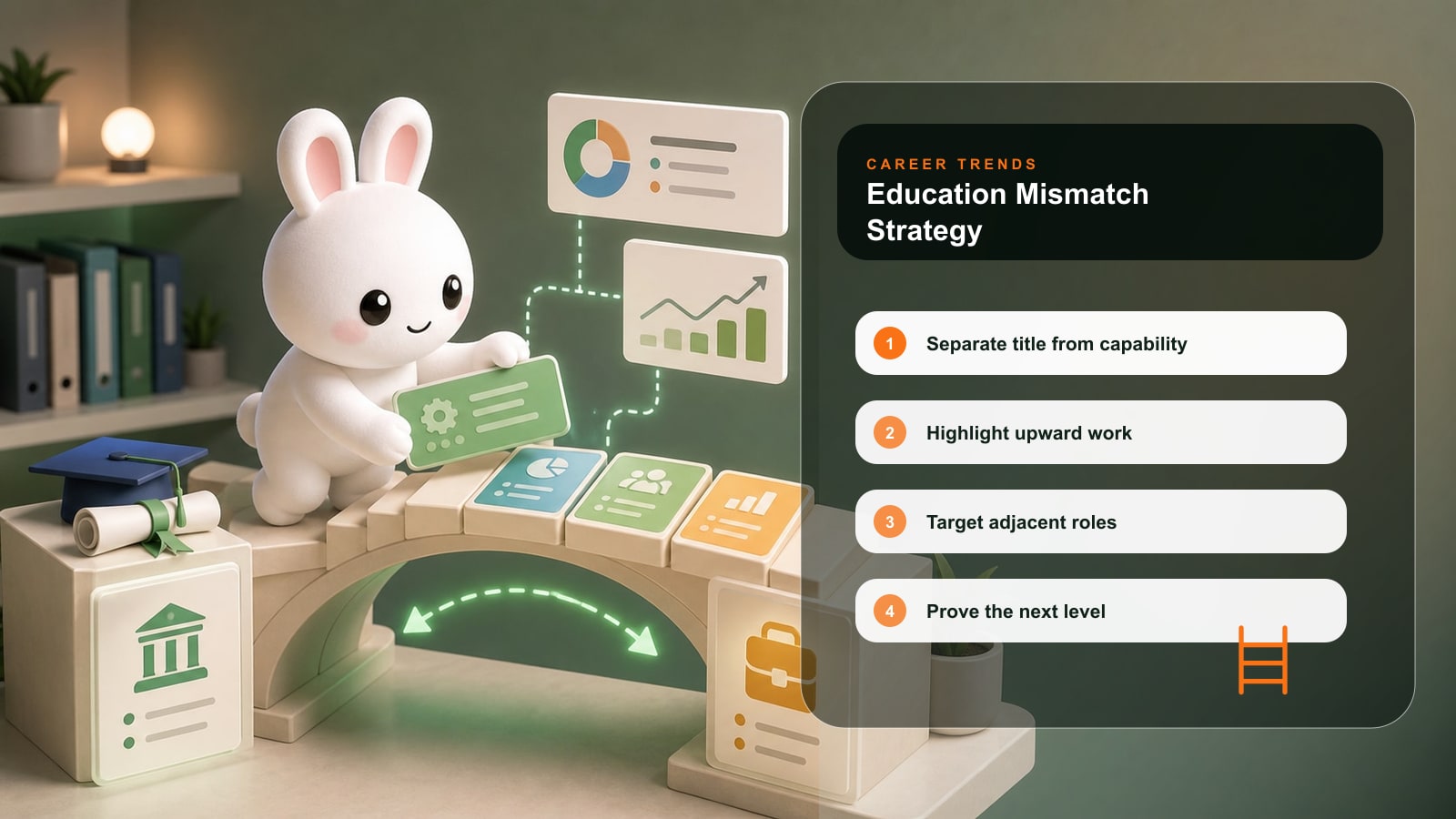
Overeducation usually means workers have more formal education than the occupation typically requires.
The risk is that recruiters anchor on your current title instead of transferable capability.
Reposition your resume around skills, outcomes, complexity, and target-role evidence.
Use bridge roles strategically instead of applying only to dream roles or staying stuck.
Search intent: what this page helps you do
This page helps underemployed or overeducated job seekers translate current work into stronger evidence for better-fit roles.
The practical goal is not to make a resume or job-search document sound polished. The goal is to make the next reviewer understand your fit faster, with fewer assumptions and less friction.
How to reposition when your title undersells you
The goal is not to hide your current job. The goal is to explain the transferable value inside it.
| Area | What strong candidates do | What to avoid |
|---|---|---|
| Current title | Use it honestly but do not let it dominate the story. | Apologizing for the role or burying it. |
| Transferable skills | Lead with operations, analysis, customer, team, or process outcomes. | Listing duties that sound entry-level only. |
| Education | Connect degree or training to the target role. | Assuming the credential speaks for itself. |
| Bridge roles | Target adjacent jobs that value current proof. | Jumping only to roles with no evidence path. |
| Metrics | Quantify volume, speed, quality, customers, risk, or revenue. | Using vague hardworking language. |
Step-by-step workflow
- 1Identify the higher-fit role you want next.
- 2List tasks from your current role that match that target.
- 3Rewrite bullets around complexity, not job title status.
- 4Move education and projects where they support the next role.
- 5Apply to adjacent bridge roles with clearer evidence paths.
- 6Track which positioning gets responses.
Before and after examples
| Weak version | Stronger version |
|---|---|
| Worked as receptionist after college. | Coordinated scheduling, intake, and issue routing for 80+ weekly clients, reducing missed handoffs through a new tracking sheet. |
| Retail associate with business degree. | Analyzed weekly inventory and sales patterns for 1,200 SKUs, helping store manager reduce stockouts in top categories. |
| Bartender while job searching. | Managed high-volume service, cash accuracy, and customer issue resolution across 120+ nightly transactions. |
Use the stronger versions as patterns, not scripts. Replace the details with your real scope, tools, audience, numbers, and constraints.
Checklist before you use this advice
Key takeaway
Application checklist
The resume names the target role clearly.
The current job is reframed around transferable outcomes.
Education supports the target instead of floating separately.
Bridge roles are realistic and specific.
The resume does not sound defensive.
Common mistakes
| Mistake | Why it hurts | Better move |
|---|---|---|
| Hiding current work. | It creates gaps and confusion. | Translate the work honestly. |
| Relying only on degree prestige. | Employers still need role evidence. | Show applied skills and projects. |
| Applying too broadly. | Mismatch persists when targeting is weak. | Build a focused bridge strategy. |
How Rezoomed helps
Rezoomed Resume Builder and Match Score help underemployed candidates create targeted versions that translate current work into better-fit evidence.
Use the relevant Rezoomed tool after you have a clear target role, not before. The tool is most useful when it has a real job description, a real resume, and a concrete outcome to improve.
Fast answers to common questions
Frequently asked questions
- 01+
What is underemployment?
Underemployment can mean working fewer hours than desired or working in a role that does not use your education, skills, or experience fully.
- 02+
Should I remove low-level jobs from my resume?
Not automatically. Keep roles that explain recent work history or transferable proof, but rewrite them for the target role.
- 03+
How do I move out of underemployment?
Target adjacent roles, build proof projects, rewrite transferable bullets, and apply where your current evidence already supports the next level.
Final takeaway
The strongest applications are specific, readable, and easy to verify. Use this guide to remove uncertainty: show the role you want, prove the work you have done, and keep every claim defensible in an interview.
Sources and further reading
- Federal Reserve Bank of New York: Recent College Graduates
- St. Louis Fed: Underemployed college graduates
- MyPerfectResume: Overeducated Workforce
Related Rezoomed tools
- ATS Checker - Check structure, keywords, and readability before sending your resume.
- Pricing - See the full Rezoomed workflow if you need more than a one-off resume check.