The best U.S. resume format is clear, direct, and easy to scan. It should help recruiters understand your fit quickly and help ATS software parse the document without layout problems.
Key takeaway
Quick answer
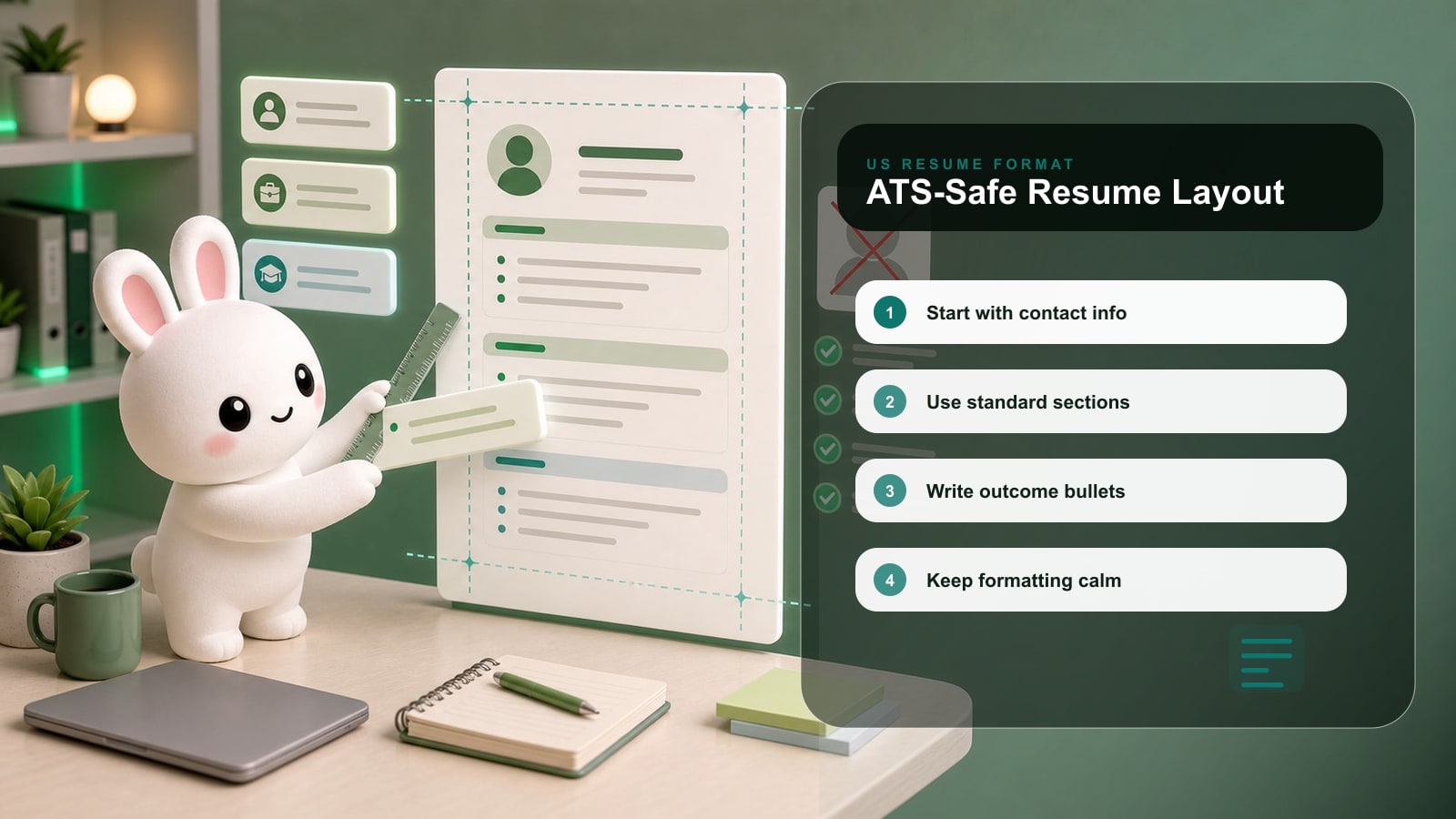
Use contact information, summary, experience, skills, education, and optional certifications or projects.
Do not include a photo, birth date, marital status, nationality, or full street address for most U.S. roles.
Use one column, standard headings, readable fonts, and simple bullets.
One page works for many earlier-career candidates; two pages can work when experience justifies it.
Search intent: what this page helps you do
This guide helps job seekers format a U.S. resume for online applications, ATS parsing, and recruiter readability.
The practical goal is not to make a resume or job-search document sound polished. The goal is to make the next reviewer understand your fit faster, with fewer assumptions and less friction.
U.S. resume format section-by-section
Use this order for most U.S. applications unless your field has a specific convention.
| Area | What strong candidates do | What to avoid |
|---|---|---|
| Header | Name, phone, professional email, LinkedIn, portfolio, city/state. | Photo, full address, personal details. |
| Summary | Two to four lines tied to target role. | Generic objective about seeking opportunity. |
| Experience | Reverse chronological bullets with outcomes. | Responsibilities with no proof. |
| Skills | Grouped hard skills and tools. | Soft-skill dumps. |
| Education | Degree, school, field, graduation year when useful. | Overly detailed coursework unless relevant. |
Step-by-step workflow
- 1Choose a one-column layout.
- 2Write a clear contact header.
- 3Add a role-targeted summary.
- 4Use reverse chronological experience.
- 5Rewrite bullets with action, scope, and result.
- 6Group skills by relevance.
- 7Export a text-based PDF unless the employer asks for DOCX.
Before and after examples
| Weak version | Stronger version |
|---|---|
| Objective: To obtain a challenging position where I can grow. | Summary: Data analyst with 4 years building SQL reporting, Tableau dashboards, and revenue operations insights for SaaS teams. |
| Responsible for customer reports. | Built weekly Salesforce reports for 14 CSMs, reducing manual account review time by 6 hours per week. |
| Skills: leadership, teamwork, communication. | Analytics: SQL, Tableau, Excel. Operations: onboarding, SLA reporting, renewal-risk tracking. |
Use the stronger versions as patterns, not scripts. Replace the details with your real scope, tools, audience, numbers, and constraints.
Checklist before you use this advice
Key takeaway
Application checklist
No photo or unnecessary personal information.
Contact information is in the body of the resume, not only a header/footer.
Section names are standard.
Bullets show outcomes and scope.
The resume is easy to skim in 10 seconds.
Common mistakes
| Mistake | Why it hurts | Better move |
|---|---|---|
| Using a photo. | It is usually unnecessary for U.S. resumes and can create bias concerns. | Keep the header professional and text-based. |
| Overdesigning the layout. | ATS parsing can break. | Use clean structure and spacing. |
| Making every bullet a duty. | Duties do not prove performance. | Add scope, tools, and outcomes. |
How Rezoomed helps
Rezoomed Resume Builder helps create U.S.-style resumes with ATS-safe sections, while ATS Checker catches parseability and formatting issues before you apply.
Use the relevant Rezoomed tool after you have a clear target role, not before. The tool is most useful when it has a real job description, a real resume, and a concrete outcome to improve.
Fast answers to common questions
Frequently asked questions
- 01+
Should a U.S. resume be one page?
One page is common for students and earlier-career candidates. Two pages can work when the added experience is relevant.
- 02+
Should I include references?
No. Do not include references or References available upon request unless specifically asked.
- 03+
Is PDF or DOCX better?
Follow the employer instructions. If both are accepted, use a clean text-based PDF or DOCX.
Final takeaway
The strongest applications are specific, readable, and easy to verify. Use this guide to remove uncertainty: show the role you want, prove the work you have done, and keep every claim defensible in an interview.
Sources and further reading
Related Rezoomed tools
- Resume Format Guide - Use the format hub for section order, ATS-safe rules, examples, and role-specific formats.
- ATS Resume Format - Apply the safest layout rules before you upload the resume to employer portals.
- Resume Builder - Rebuild the resume in a cleaner structure and export a more application-ready version.