A strong cover letter does not summarize your entire resume. It makes one clear argument: the role needs something specific, and your experience proves you can help.
Key takeaway
Quick answer
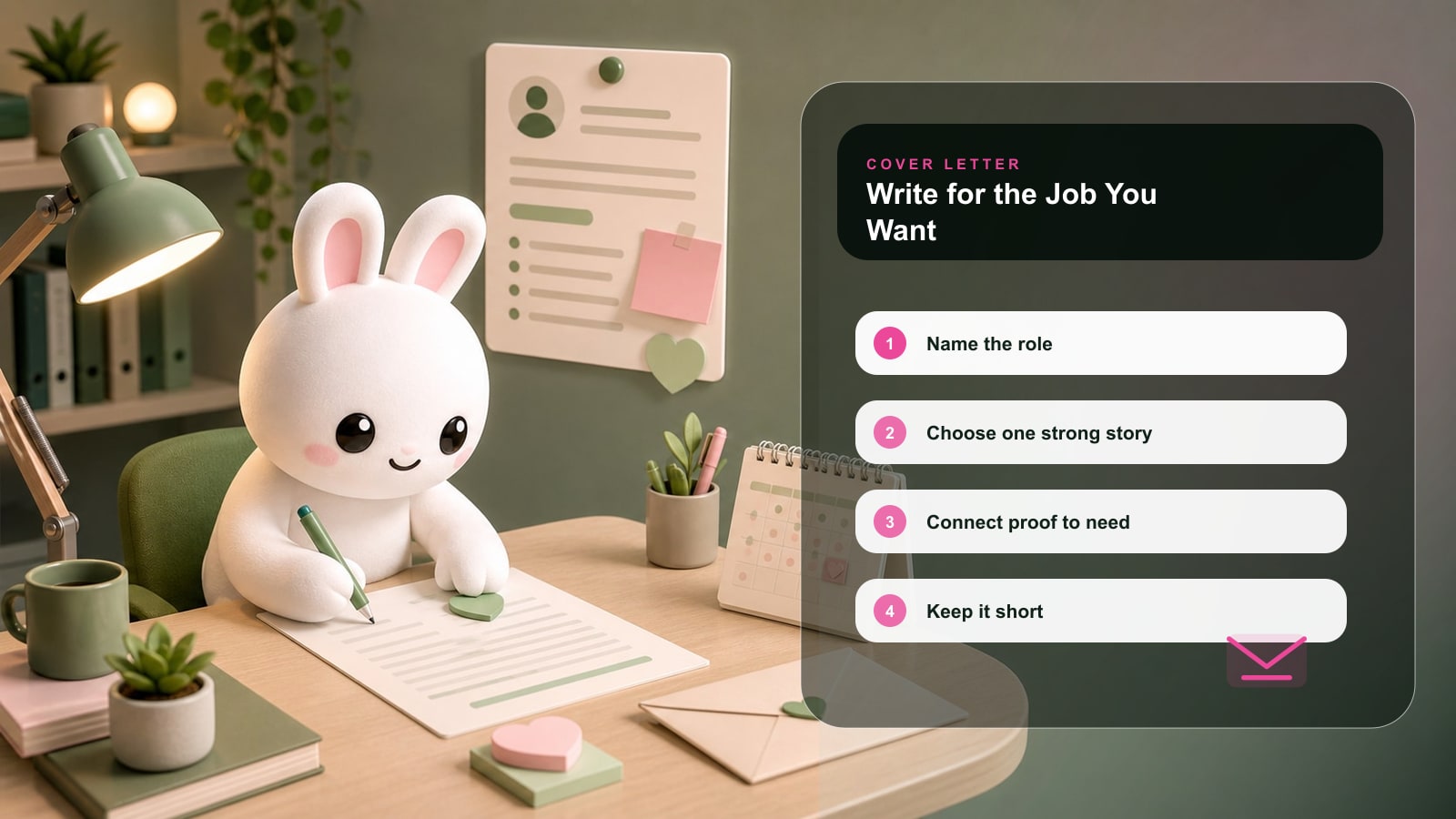
Open with the role and one specific reason your background fits.
Use one or two proof paragraphs tied to the job description.
Keep it concise and easy to skim.
Close with confidence, not pressure.
Search intent: what this page helps you do
This guide is for candidates who care about a specific job enough to write a real letter rather than paste a generic template.
The practical goal is not to make a resume or job-search document sound polished. The goal is to make the next reviewer understand your fit faster, with fewer assumptions and less friction.
Cover letter structure that works
Use this structure to keep the letter useful, short, and tied to the employer need.
| Area | What strong candidates do | What to avoid |
|---|---|---|
| Opening | Name the role and connect your strongest relevant angle. | Starting with To whom it may concern if a better option exists. |
| Proof paragraph | Use one real story, metric, or outcome. | Listing every responsibility from the resume. |
| Company connection | Reference the team, product, customer, or problem. | Generic admiration. |
| Tone | Professional, direct, and human. | Overly formal or overly casual. |
| Close | Invite conversation and thank them. | Begging for a chance or overselling. |
Step-by-step workflow
- 1Read the job description and identify the top 2 responsibilities.
- 2Choose one resume achievement that proves the first responsibility.
- 3Write a short opening paragraph with the role and fit.
- 4Write one proof paragraph with context, action, and outcome.
- 5Add a short company-specific line.
- 6Close cleanly and keep the full letter under one page.
Before and after examples
| Weak version | Stronger version |
|---|---|
| I am writing to express my interest in the open role at your company. | I am applying for the Customer Success Manager role because my recent work reducing onboarding delays by 28% maps directly to your focus on faster enterprise activation. |
| I have many skills that would make me a good fit. | At Northstar, I led onboarding reporting for 45 accounts and built a renewal-risk dashboard that gave managers earlier visibility into stalled accounts. |
| Please give me the opportunity to prove myself. | I would welcome the chance to discuss how my onboarding and reporting experience could support the team. |
Use the stronger versions as patterns, not scripts. Replace the details with your real scope, tools, audience, numbers, and constraints.
Checklist before you use this advice
Key takeaway
Application checklist
The letter is tailored to one job.
The opening mentions the role.
The proof paragraph includes a real achievement.
The company reference is specific enough to be credible.
The final letter is concise and free of filler.
Common mistakes
| Mistake | Why it hurts | Better move |
|---|---|---|
| Repeating the resume. | It wastes the cover letter opportunity. | Add context around one strong proof point. |
| Writing too long. | Recruiters skim quickly. | Cut to the argument. |
| Using generic praise. | It does not prove fit. | Connect to the role need. |
How Rezoomed helps
Rezoomed Cover Letter Generator helps turn your resume and job description into a focused first draft you can edit into a human, role-specific letter.
Use the relevant Rezoomed tool after you have a clear target role, not before. The tool is most useful when it has a real job description, a real resume, and a concrete outcome to improve.
Fast answers to common questions
Frequently asked questions
- 01+
Do cover letters still matter?
They matter most when the employer asks for one, when the role is highly targeted, or when you need to explain motivation, transition, or fit.
- 02+
Should a cover letter be one page?
Yes. Usually 3 to 5 short paragraphs is enough.
- 03+
What if I do not know the hiring manager name?
Use a professional greeting such as Dear Hiring Team. Do not force a name if you are unsure.
Final takeaway
The strongest applications are specific, readable, and easy to verify. Use this guide to remove uncertainty: show the role you want, prove the work you have done, and keep every claim defensible in an interview.
Sources and further reading
Related Rezoomed tools
- Cover Letter Generator - Turn your resume plus the target role into a faster first-draft cover letter.
- Resume Builder - Tighten the resume first so the cover letter pulls from stronger material.